






The near-infrared absorbing (color correction) filter glass is a deep blue-green (CIE color system chromaticity notation: x: 0.254-0.280, y: 0.318-0.325).
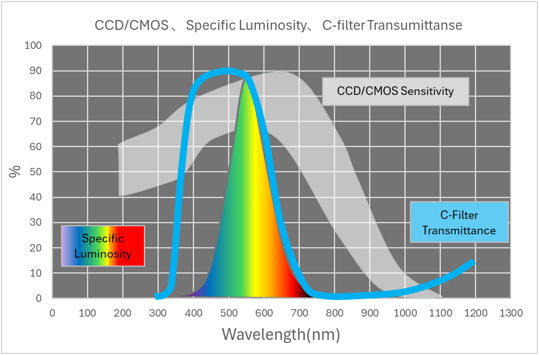
It transmits light from 400-550 nm and absorbs light from 600-1000 nm (up to 300 nm), making it effective for correcting the sensitivity of image sensors such as CCD and CMOS, which have sensitivity to longer (shorter) wavelengths than human visual sensitivity.
The figure on the below shows human visual sensitivity, example sensitivity curves for CCD and CMOS, and example transmittance of near-infrared absorbing filter glass.
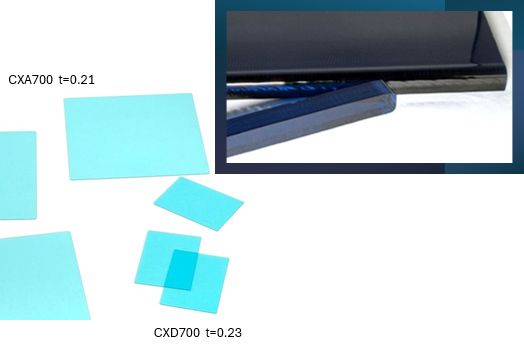
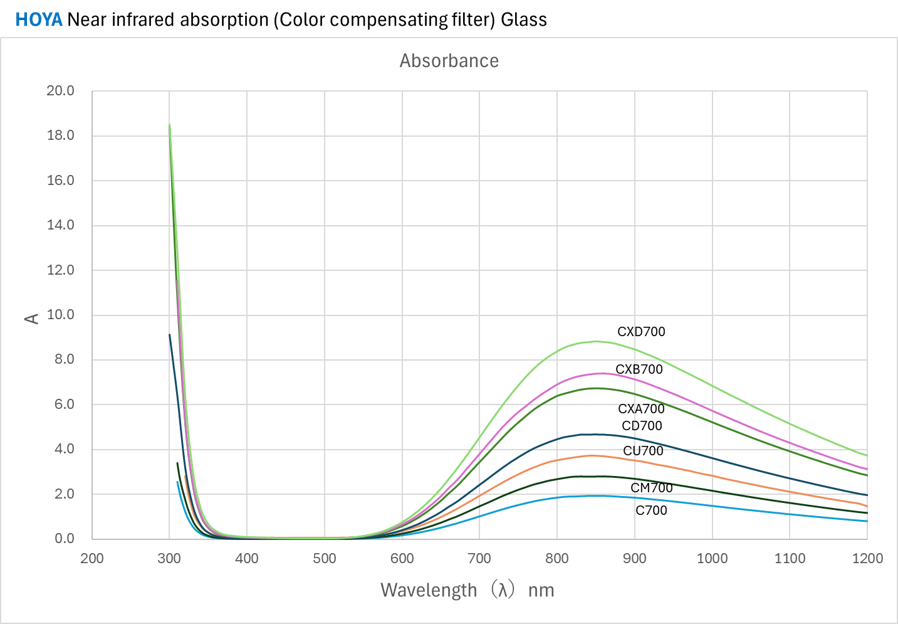
HOYA's near-infrared absorption filters come in seven glass types with differing absorption strengths, allowing you to select the filter that best suits your application.
The filters, in order of strongest absorption in the near-infrared range, are CXD700, CXB700, CXA700, CD700, CU700, CM700, and C700.
Each glass type has a standard thickness, and some glass types have standard values for the wavelength range where transmittance is 50% at that thickness, as well as upper and lower limits for each wavelength.

* Click on the figure to see a larger figure.
* Click on the figure to see a larger figure.
The filter characteristics are indicated by the transmittance (T), Internal Transmittance (τ), absorbance (A), and extinction coefficient (K). These values are calculated using the following relationship.
| Transmittance (T) | T=I/I0 |
| I0: Incident light intensity, I: Transmitted light intensity | |
| Internal Transmittance (τ) | τ=T+R |
| R: Reflection loss | |
| Absorbance (A) | A=αL=-logτ・・・・・From Lambert-Beer's law |
| α: Absorption coefficient, L: Thickness | |
| Extinction coefficient (K) | K=αλ/4π |
| λ: Wavelength |
Transmittance is measured using a spectrophotometer.
Refractive index, chemical properties, thermal properties, mechanical properties, and specific gravity are measured using the same methods as for optical glass.
HOYA near-infrared absorption filter glass is produced using high-purity raw materials equivalent to those used in optical glass, using a special melting method.
Quality is guaranteed through inspections and measurements based on strict quality standards.